Citations, and why models invent them
A student submits an essay with fourteen references. Eleven exist. Two exist but say something different from what was claimed. One does not exist at all — plausible authors, plausible journal, plausible year, plausible title, and no such paper was ever written.
This has happened enough times, to enough people, including lawyers in actual courtrooms and researchers in submitted manuscripts, that it deserves a lesson of its own. It is not carelessness. It is a direct, predictable consequence of what the machine is, and once you understand the mechanism you will never be caught by it.
The mechanism
A language model generates text by producing what should plausibly come next. It has no reference database it consults and no notion of a fact being checked. Trained on millions of citations, it has learned the shape of one extremely well: author surnames like these, a title in this style, a journal that publishes this kind of work, a volume number in this range.
So when you ask for a citation, it produces something citation-shaped. Sometimes the shape is filled with a real paper it saw often in training. Sometimes it is filled with a composite that has never existed. From the inside, these two operations are identical — there is no internal signal distinguishing "recalled" from "constructed", which is why the fabricated ones come with exactly the same confidence as the real ones.
This is the same phenomenon as hallucination generally; citations are simply where it is most dangerous for you, because a fabricated citation is a specific, checkable, documented false claim with your name on it.
Where the risk is highest
Highest: asking a chatbot with no search for references on a topic. Everything it gives you is generated. Treat the entire list as unverified.
High: asking for a citation to support a claim you have already written. This is the worst pattern, because you are asking it to find evidence for a conclusion, and the path of least resistance is to construct exactly the paper you described.
Moderate: page numbers and quotes from a real paper. The paper exists; the page number may be invented, and a quote may be a paraphrase presented in quotation marks — which is a misquotation, and is treated as one.
Low but non-zero: AI search tools that retrieve before answering. The sources are real because they were fetched. What can still go wrong is the link between source and claim — the tool cites a real paper for a statement that paper does not actually make. Less common and much harder to spot, because clicking the link shows you a real paper and most people stop there.
The verification loop
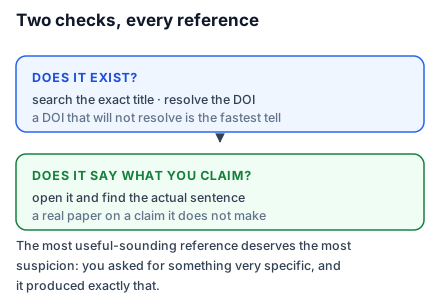
Two checks per reference. Neither is optional and together they take about two minutes.
Does it exist? Search the exact title in Google Scholar or your library. Then check the DOI resolves — paste it after https://doi.org/ and see whether you land on the paper. A DOI that does not resolve is the fastest possible detection of a fabricated reference, because DOIs are issued by registries and a model cannot invent a working one.
Does it say what you claim? Open it and find the actual sentence. This catches the subtler failure, which is a real paper attached to a claim it does not support — and that failure is more common than outright fabrication and considerably more embarrassing, because it looks like misrepresentation rather than error.
A practical detail worth knowing: check every reference in the final draft, not as you go. References move, get replaced, and get carried over from earlier drafts. The check that counts is the one against the list you are actually submitting.
Reference managers, which solve most of this
Zotero is free, works everywhere, and its browser extension saves a reference from a paper's page in one click — with the metadata correct, because it came from the source rather than from a model.
The reason this matters here is structural: a reference in Zotero got there by you visiting the paper. A reference in your document that is not in Zotero is one you have not opened, which is exactly lesson 4's rule made mechanical. The bibliography is then generated in whatever style, correctly, in a second — a task, fully delegable, and the one part of citation work that should cost you nothing.
What it costs to get this wrong
For a student: an academic misconduct process, at minimum a mark of zero. Fabricated references are treated more seriously than most plagiarism, because they are evidence of a claim to have read something you did not.
For a researcher: retraction, and a permanent, searchable association between your name and the incident.
And the thing worth internalising is that it is easy to detect. A marker who suspects anything checks three references in four minutes. There is no version of this that goes unnoticed if anyone looks.
Ananya's near miss
Early on, before she had the habit, Ananya asked for "key papers on daytime versus night-time urban heat island measurement". She got six references. Four were real. One was a real author paired with a title he had not written. One was entirely invented — and it was, inconveniently, the one that most precisely supported the argument she wanted to make.
That is not a coincidence, and it is the detail worth remembering. The most useful-sounding reference is the most likely to be fabricated, because you asked for something specific and the model produced exactly what you asked for. The reference that perfectly supports your thesis deserves the most suspicion, not the least.
Do this today: take any AI-produced reference list you have and check every DOI. Two minutes each. Whatever you find will make this lesson permanent.