The bargain you are actually making
Every student using AI is making a trade, and most are making it without noticing. The trade is this: you can hand over almost any piece of academic work, and some of what you hand over costs you nothing, while some of it costs you the thing you came to university to get.
That is not a moral warning. It is a practical one, and the distinction it rests on is learnable in about ten minutes. This course is built on it.
Meet Ananya
Ananya is in the second year of an urban planning degree. She has three weeks and a 3,000-word term paper on urban heat islands — how cities get hotter than the countryside around them, and what can be done about it. She has a mid-term in the same window. She has never written anything this long, she has a reading list of forty items she has not opened, and she has a chatbot in a browser tab.
We are going to follow that paper from the reading list to the submitted draft, and follow the mid-term alongside it. Everything in this course is something Ananya does, with the specific prompts and the specific mistakes.
Tasks and skills
Here is the whole distinction.
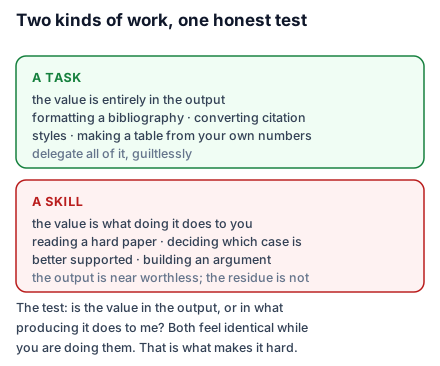
A task is a piece of work whose value is entirely in its output. Formatting a bibliography. Converting your reference list from one citation style to another. Making a table out of numbers you already have. Rewriting a paragraph you wrote badly into a paragraph that says the same thing well. Nobody is examining you on your ability to format a bibliography, and nobody ever will. Delegate all of it, guiltlessly, and take the time back.
A skill is a piece of work whose value is in what doing it does to you. Reading a difficult paper and working out what it argues. Deciding which of two explanations of a phenomenon is better supported. Constructing an argument that survives an objection. Sitting with confusion long enough for it to resolve. The output of these — a set of notes, an outline, an essay — is almost worthless. The residue in your head is the entire point, and it is what your degree is a claim about.
Hand over a task and you lose nothing. Hand over a skill and you get an output that looks identical to the one you would have produced, minus the only thing that mattered.
Why this is genuinely hard to feel
The problem is that both feel exactly the same while you are doing them. Both produce a document. Both take the item off your list. The difference does not show up until an exam, a viva, an interview, or the first week of a job — at which point it shows up completely.
Ananya's first instinct with the reading list was to paste each paper into a chatbot and ask for a summary. Forty papers, forty summaries, one afternoon. It felt like enormous progress. Two days later she could not remember which paper had argued what, could not tell which of them disagreed with each other, and had no sense of where the open questions were — which is precisely what a literature review is for. She had generated forty documents and acquired nothing.
That failure is the subject of the next lesson, because it is the central one and it has a specific mechanism.
The rule this course runs on
Delegate the task; do the skill; use AI to make doing the skill faster and less lonely.
That third clause is where most of the value in this course actually lives, and it is what people miss when they set the whole thing up as a choice between cheating and abstaining. AI is genuinely excellent at things that make hard cognitive work easier without doing it for you: explaining a paragraph you are stuck on, generating practice questions from your own notes, arguing against your thesis so you can strengthen it, telling you what a term means the fourth time you have forgotten, at 1am, without judgement.
A good tutor does exactly those things and does not write your essay. You now have something that will do them at any hour, and the whole craft is in asking for the tutoring instead of the essay.
What this course covers
Studying so it sticks. Finding sources that exist. Reading things above your level. Notes that are still useful in April. Building an argument. Where the writing line is, and how to find out where your institution draws it. Citations, and why models invent them. Exams. Group work and programming assignments. And, for those going further, the literature review done properly.
Ananya, by the way, gets a good grade on the paper. She also gets a moment in a seminar where she can defend a claim under questioning, which is the part that mattered.
Do this today: take your current workload and split it into two lists, tasks and skills, using the test above — is the value in the output, or in what producing it does to me? Be honest about the ambiguous ones. That list is the syllabus for how you should use AI this term.