Writing: where the line actually is
This is the lesson everyone wants and nobody can give you the final version of, because the rule is set by your institution and institutions differ. What this lesson gives you is a workable default, a way to find out what your actual rule is, and a test that works when the rule is silent.
The default traffic light
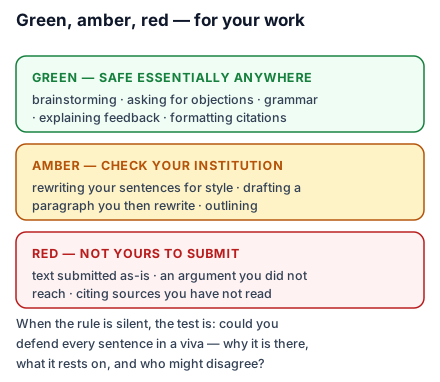
Green — help with your thinking and your prose, on work that is yours. Brainstorming angles before you commit. Asking for objections to your argument. Getting an explanation of feedback you did not understand. Grammar and spelling. Asking whether a paragraph is clear. Asking what is missing from your draft. Formatting citations. Translating your own writing between registers. In each of these the ideas and the sentences are yours, and the assistant is doing what a good writing centre does.
Amber — depends on your institution, and you must check. Rewriting your sentences for style. Generating a paragraph you then substantially rewrite. Producing an outline from your own notes. Translating your own text from another language into English. Every one of these is explicitly permitted at some universities and explicitly prohibited at others. The variation is real and it is not resolved by anything in this course.
Red — not yours to submit, essentially everywhere. Generating text you submit largely as-is. Producing an argument you did not reach. Fabricating or padding citations. Having AI write about sources you have not read. Submitting AI text with the AI-ness edited out to avoid detection — which is worse than the original act, because it demonstrates intent.
How to find your actual rule in ten minutes
Search your university's site for academic integrity generative AI. Most institutions published a policy between 2023 and 2025.
Then check your module handbook, because the module rule overrides the university one and is frequently stricter. Then check the assignment brief itself, which overrides both.
Then, if it is still ambiguous — and it often is — email the module convenor with a specific question rather than a general one. Not "can I use AI?" but "may I use an AI assistant to generate objections to my argument, which I then respond to in my own words?" A specific question gets a specific answer, in writing, and that email is a complete defence if anything is ever queried.
Ananya's department permitted AI for "planning, structuring, and language support" and prohibited it for "generating substantive content". Her use of the objections prompt sat inside that, and she said so in her acknowledgement.
The test for when the rule is silent
Could you sit in a viva and defend every sentence — explain why it is there, what it rests on, and what you would say to someone who disagreed?
That is the underlying standard almost every academic integrity policy is a specific expression of. It is also a good predictor: work that passes it is rarely queried, and work that fails it tends to fail visibly and at the worst moment.
A second, blunter version: would you be comfortable if your marker watched a recording of how this was produced? Discomfort here is information.
What good AI-assisted revision actually looks like
You have a bad first draft. Here is a sequence that is defensible under any policy that permits language support, and which genuinely improves the essay.
"Here is my draft. Do not rewrite it. Tell me: where is the argument unclear, where do I assert something without evidence, and where am I repeating myself?" Then you fix those, yourself.
"Which paragraph is the weakest, and why?" Then you rewrite it, yourself.
"Read my introduction and tell me what you expect the essay to argue. Then read my conclusion and tell me what it actually argued." A gap between those two answers is a structural problem you cannot see from inside the draft, and this is the most useful revision prompt there is.
"List every claim I make that a marker would want a citation for." Then you go and get them, or soften the claims.
Notice that none of these produce text. They produce a list of things for you to do, which is what a good supervisor produces, and the essay that results is entirely yours.
The acknowledgement
Increasingly, institutions ask for a statement of how AI was used, and increasingly it is graded on honesty rather than abstinence. Write one even when it is not required. Ananya's was two sentences: "I used Claude to generate counter-arguments to my thesis, which I address in sections 3 and 4, and to check my summaries of sources against the originals. All text, analysis, and source selection are my own."
That statement is specific, it is checkable, and writing it is a good discipline — anything you would rather not write down is a signal about the thing itself.
Do this today: find your institution's actual policy and your module's rule, and read them. Ten minutes, and it converts the most anxiety-producing part of this whole topic into a known quantity.