Reading a paper you are not ready for
Academic papers are written by specialists for specialists, and nobody tells undergraduates this, so the first few produce a specific kind of despair: you read every word, understand each sentence individually, and reach the end with no idea what happened.
That is not a failure of intelligence. It is a failure of method, and the method is fixable. AI helps enormously here, in a way that is entirely legitimate, provided you keep one part for yourself.
The three-pass method
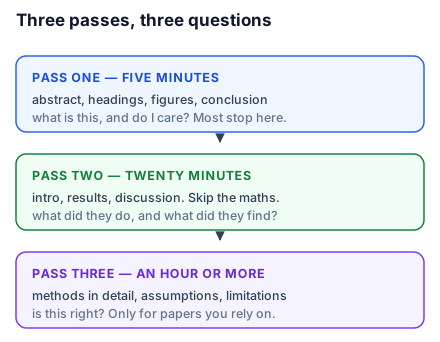
Pass one, five minutes: what is this and do I care? Title, abstract, section headings, figures and their captions, conclusion. Nothing else. Then answer, in your own words: what question does this ask, and what did it find? If you cannot, read the abstract again — not the whole paper.
Most papers should stop here. That is the pass working.
Pass two, twenty minutes: what did they do and what did they find? Introduction properly, methods skimmed for shape rather than detail, results with attention to the figures, discussion properly. Skip the mathematics on this pass entirely. You are after the argument, and in most papers the argument is fully carried by the prose and the figures. Come out with: what did they measure, on what, and what was the finding.
Pass three, an hour or more: is this right? Only for the handful of papers your work genuinely rests on. Now the methods in detail, the assumptions, the sample, what the limitations section admits, and what it does not admit. You are looking for the gap between what was demonstrated and what is claimed — which is where every interesting essay argument comes from.
Most students attempt pass three on every paper, exhaust themselves on the third one, and conclude they are bad at reading. The passes are the fix.
Where the assistant belongs
Legitimate and excellent: unblocking. You have read a paragraph three times and it will not open. Paste it and ask "explain this paragraph, and tell me what background I am missing that would make it obvious." That second clause is the gold — it names the concept you are lacking, which is usually the actual problem and takes four minutes to fix.
Legitimate: decoding notation and jargon. "In this field, what does this symbol mean in this context?" You are not outsourcing understanding; you are getting a dictionary that understands context.
Legitimate: interrogation after you have read it. "I think this paper argues X. What have I misread?" Note the shape — you formed the view, and the assistant is checking it. That is the reverse of the failure in lesson 2, and it is safe for exactly that reason.
Legitimate: methods translation. "Explain in plain English what a fixed-effects model is doing here and what it controls for." Methodological vocabulary is a genuine barrier that has very little to do with the intellectual content of your field.
Not legitimate, and the one to guard: reading pass one for you. The abstract and the conclusion are four hundred words. Read them yourself, always. They are where the paper tells you what it thinks it did, and forming your own first impression of that is the skill this entire lesson protects. Once you have it, use every tool available.
The mistake worth naming
Do not ask "what are the limitations of this paper?" and write down the answer. You will get a fluent, generic list — small sample, limited generalisability, correlation not causation — that is true of nearly every paper and therefore says nothing about this one.
Ask instead: "The authors claim tree cover reduces peak surface temperature by up to 4°C. What would have to be true of their sites and measurement for that to generalise to a dense Indian city?" Now the answer is about this paper, and evaluating it is your work.
The general pattern: a question with your own thinking already in it gets a useful answer; a question without any gets a plausible average.
Ananya's paper
The 2023 review was straightforward. The one that mattered was a modelling paper whose methods section was impenetrable — three pages of equations describing an energy balance model.
Pass one: what does it ask and find, from the abstract. Pass two, skipping every equation: it models how much cooling you get from different amounts of tree canopy in different urban densities, and finds the benefit saturates surprisingly early. That finding is what her essay uses, and she had it in twenty-five minutes without touching the mathematics.
Then, for pass three, she asked the assistant to explain what the energy balance model was doing conceptually and what it assumed. The answer named an assumption — constant wind speed — that she could then check against the limitations section, where it was indeed acknowledged. That became a paragraph in her essay about why the saturation point might sit differently in a city with different building geometry.
That paragraph is original analytical work. It exists because she used the tool to get past a barrier that was about mathematics rather than about urban planning, which is not the thing she is being examined on.
Do this today: take the hardest thing on your reading list and do pass one only — abstract, headings, figures, conclusion, five minutes — then write two sentences from memory on what it argues. Stop there. You will know more than from an hour of reading it front to back.