Finding sources without drowning
Ananya's reading list had forty items. Real research has forty thousand. Finding the right things to read is a skill in itself, the tools for it changed completely in about two years, and each of them is good at something different.
What each tool is actually for
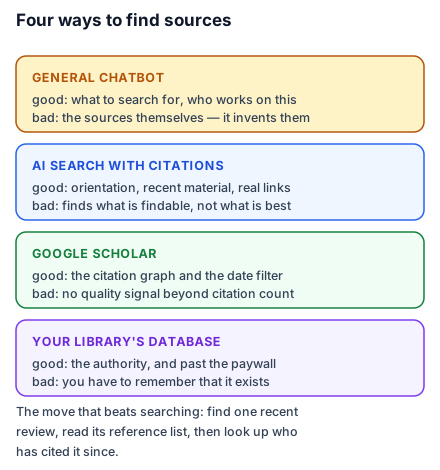
A general chatbot is good for orientation and bad for sources. Ask it what the major debates in a field are, what a term means, or which researchers are associated with an idea, and you will get a useful map. Ask it for a reading list and you will get titles that sound exactly right and may not exist. This is not a bug that will be fixed by asking more politely; lesson 9 explains the mechanism. Use it to find out what to search for, never as the search itself.
An AI search tool with citations — the kind that searches the web and cites what it used — is the honest version of the above. Because it retrieves before it answers, the sources are real and you can click them. It is excellent for orientation on a new topic and for recent material. Its weakness is that it finds what is findable and popular, which for an academic topic skews toward blog posts, news coverage, and whatever is open access, and it will happily cite a content-marketing page next to a review article.
Google Scholar remains the workhorse and is the one students most underuse. Its two superpowers are the citation graph and the date filter. "Cited by" on a foundational paper, sorted by year, is the single most efficient way to find out what happened next in a field. Set up an alert on your topic and the literature comes to you for the rest of the project.
A domain database — your library's subscription, PubMed, arXiv, SSRN, whatever your field uses — is where the actual authority is, and it is the one that gets you past paywalls, because your institution already paid. Ananya found roughly a third of her sources through her university library and would have paid for four of them otherwise.
The workflow that combines them: chatbot to learn the vocabulary, AI search to orient, Scholar to find the real literature and follow the citation graph, library database to actually read it.
The strategy that beats searching
Find one excellent recent review article or meta-analysis on your topic. Read its reference list. That is a curated, expert-selected reading list, and it took a specialist months to assemble.
Then look up who has cited that review since. You now have both directions — the foundations behind it and the work since — and you have done it in an hour. Ananya's twelve papers came almost entirely from one 2023 review and its citation graph.
To find that review, the search term is literally review or meta-analysis alongside your topic, with a date filter. It is not subtle and it works.
Reading enough to decide what to read
You cannot read forty papers, and you should not try. Triage in three passes.
Title and abstract, one minute. Does this address my question? Most do not. Discard freely — the discipline to discard is the skill here.
Introduction and conclusion, five minutes. What does it claim, and is the claim relevant to what I am arguing? Keep, discard, or maybe.
Full read, forty minutes. Only for the ones that survived, and lesson 5 is entirely about doing this well.
For a 3,000-word essay you will fully read eight to twelve things. That is not cutting corners; it is what the assignment is asking for. Twelve papers understood well produce a better essay than forty skimmed, and the difference is visible in a single paragraph to anyone marking it.
Where AI helps in the triage, safely
Feeding an abstract in and asking "does this address whether tree cover reduces urban heat island intensity, or something adjacent?" is a legitimate and excellent use, because the abstract is in front of you and you can check the answer immediately. It is a task, not a skill — you are filtering, not understanding.
The line is where the summary substitutes for reading something you decided to keep. Triage with AI; read the survivors yourself.
The one rule about sources
Never cite anything you have not opened. Not skimmed — opened, and read enough of to know what it argues.
This sounds obvious and is broken constantly, because a citation from an AI summary or from another paper's reference list is so easy to carry across. It is how errors propagate through literatures for decades, it is how students end up citing a paper that says the opposite of what they claimed, and — practically — it is what an examiner asking "what did that study actually find?" will discover in about eight seconds.
Do this today: find one recent review article on the topic you are working on, and mine its reference list for five papers. That hour will do more for your project than any prompt in this course.