The thing nobody tells you: it can make you worse
This is the most important lesson in the course, and it is the one you will be tempted to skip because it sounds like a lecture. It is not a lecture. It is a description of a specific cognitive failure that is easy to fall into, feels excellent while it happens, and is well documented.
The illusion of fluency
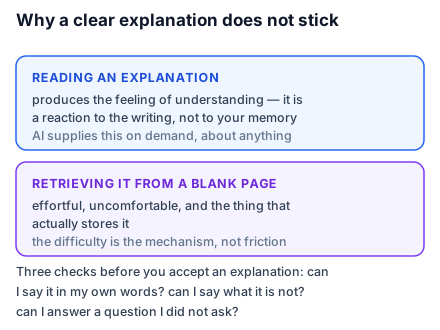
When you read a clear explanation of something difficult, your brain produces a distinct sensation: I understand this. That sensation is generated by the clarity of the text, not by anything having been stored in your memory. It is a reaction to the writing.
This has been studied for decades in the learning literature under names like the fluency illusion, and it is the reason highlighting a textbook feels productive and does almost nothing. AI has made it dramatically more available, because AI produces unusually clear explanations of arbitrarily difficult things, on demand. You can now generate the feeling of understanding about anything, in seconds, without limit.
Ananya's forty summaries were forty doses of this. Each one, while she read it, produced genuine comprehension. None of it survived, because nothing had happened to her memory — the understanding lived in the document, and she had confused having access to it with having it.
The mechanism that actually stores things
The finding that matters here is unglamorous and extremely well supported: you remember what you retrieve, not what you re-read. Effortfully pulling something out of your own head — from a blank page, before checking — does far more for retention than reading the same material again, even though re-reading feels much more productive at the time. This is usually called the testing effect or retrieval practice, and it is about as close to settled as findings in this area get.
The second finding, related: difficulty during learning is often a feature. Struggling to reconstruct an idea, getting it slightly wrong, and correcting it produces stronger retention than being handed the correct version smoothly. Learning researchers call these desirable difficulties, and the important word is desirable.
Put those together and the risk becomes obvious. AI is a machine for removing difficulty and increasing fluency. Pointed at a task, that is pure gain. Pointed at a skill, it removes exactly the friction that was doing the work.
The three-question test
Before you accept any AI explanation, ask yourself three things. It takes fifteen seconds and it is the single most useful habit in this course.
Can I close this and say it in my own words? Not the same words — your words, with a different example. If you cannot, you have read something, not learned it.
Can I say what it is not? Where does this idea stop applying? What would a counter-example look like? Genuine understanding has edges; fluency does not.
Could I answer a question about this that isn't the one I asked? The sideways question is the test. If you understand why cities form heat islands, you should be able to say something sensible about why a city with a lot of tree cover forms a weaker one, without asking.
Fail any of the three and the fix is not to re-read. It is to close the tab and write what you remember on a blank page — which will be uncomfortable, and that discomfort is the mechanism working.
What this looks like in practice
Ananya restarted her reading. Instead of "summarise this paper", she used three moves.
She read the abstract and conclusion herself, then wrote two sentences on what she thought the paper argued — from her own head, on paper, before opening any tool. Then she asked the assistant to explain the two paragraphs she had genuinely not followed. Then she asked it to ask her five questions about the paper and tell her which of her answers were weak.
Papers now took twenty-five minutes each instead of three. She got through twelve rather than forty, and she could hold an argument about all twelve. The paper she wrote cites nine of them, which is a completely normal number for a 3,000-word undergraduate essay — the forty was never the requirement.
The honest caveat
None of this means AI explanations are bad. A clear explanation of a hard idea, at the moment you are stuck, is genuinely one of the best things about this technology, and students who cannot afford a tutor now have something meaningfully close to one.
The point is narrower and more precise: the explanation is the beginning of learning, not the end of it. What you do in the ninety seconds after reading it decides whether anything stays.
Do this today: take something you learned from an AI explanation this week and, without looking, write four sentences on it — including one on where it does not apply. Then check. The gap you find is the real state of your knowledge, and it is almost always a surprise the first time.