The five-part ask
By now you have felt that a good brief beats a keyword. This lesson makes the difference teachable — a recipe you can apply to any request, and the closest thing to a master key this course contains. A complete ask has up to five parts: background, task, material, constraints, and an example. You will rarely need all five; you will almost never need none.
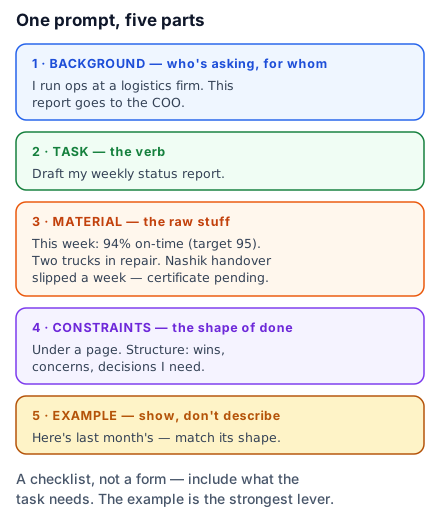
The parts, one by one
Background — who is asking, and for whom. One or two sentences of context: your role, your company, who will read the output. "I run operations at a logistics firm; this goes to the COO." Background is what stops the model writing for a generic nobody. It is the part beginners skip most, and the part that changes the output most.
Task — the verb. What you actually want done: draft, summarize, rewrite, compare, list, explain. Be direct and put it early. If you want a recommendation, say "recommend one and justify it" — otherwise you will get a diplomatic survey of options, because the model defaults to hedging.
Material — the raw stuff. The notes, the email thread, the data, the messy paragraph. Paste it right into the prompt. This is the single biggest upgrade available: a model working from your material is grounded; a model working from nothing is imagining. When Priya pastes Friday's actual meeting notes, the minutes come out about her meeting, not a plausible fiction.
Constraints — the shape of done. Length, tone, format, what to include or leave out. "Under a page." "Bullet points, not prose." "Don't mention the pending litigation." Constraints are cheap to write and expensive to omit — every unstated expectation is a revision cycle you just signed up for.
Example — show, don't describe. If you want output in a particular shape, paste a previous one you liked: "here's last month's report — match its structure and tone." One good example outperforms a paragraph of description, because the model is supremely good at pattern-matching a format. This is the strongest lever of the five and the least used.
The recipe on a real task
Priya's vendor-comparison ask, all five parts working:
Background: I'm evaluating courier vendors for our Pune-Nashik route.
Task: Compare these three quotes and recommend one, with your reasoning.
Material: [pastes the three quotes with rates, transit times, damage rates]
Constraints: Cost matters, but reliability matters more — we lost two
clients last quarter to late deliveries. Two short paragraphs, then a
one-line recommendation I can forward.
Example: (none needed here)
Notice the constraints carrying her actual priorities. Without "reliability matters more", the model would almost certainly recommend the cheapest quote — not because it is right, but because cheapest is the safest generic answer.
Three notes before you over-engineer
First, this is a checklist, not a form — a quick rewrite needs only task and material. Run through the five in your head and include what the task actually needs. Second, labels are optional; writing the parts as natural sentences works exactly as well. Third, you do not have to get it right the first time, because iteration (lesson 2) catches whatever the brief missed. The recipe just moves you from draft four to draft two.
Do this today: write the five-part version of a request you make often, and save it somewhere you can paste from — a note, a doc, anywhere. You have just started your ask library, which lesson 13 will grow into a system.