Your first real conversation
Most people's first AI session fails for one reason: they type into it the way they type into Google. A search engine takes keywords and returns links; twenty years of that habit produces prompts like "status report template" — and the assistant, given nothing to work with, returns the generic mush it was asked for. The unlock is realising you are not searching. You are briefing.
The same request, twice
Watch the difference with Priya's Monday report. Here is the search-habit version:
write a weekly operations status reportThe result will be a perfectly formatted report about nothing — plausible headings, empty phrases, somebody else's company. Now the briefing version:
I run operations for a logistics company. I need my weekly status report
for management — audience is the COO, tone is factual, length under a page.

This week: 94% on-time delivery (target 95%, last week 91%). Two trucks
down for repair, one back Thursday. The Nashik warehouse handover slipped
a week because the fire-safety certificate is pending. Hiring: 3 of 5
driver positions filled. Fuel costs up 4% on last month.

Structure it as: wins, concerns, decisions I need from them.
Same tool, same thirty seconds of typing — but the second prompt produces a draft Priya can edit into final in five minutes, because it is built from her facts, shaped for her reader. The quality of what comes back is set almost entirely by what you put in. That is the first law of working with these tools, and it never stops being true.
It remembers — until it doesn't
The second thing to understand is how the conversation itself behaves, because it is unlike any software you have used.
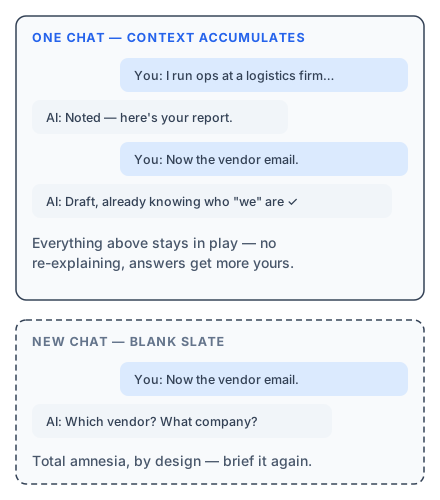
Within a single chat, everything earlier stays in play. Once Priya has briefed the assistant about her company in message one, message five can just say "now draft the vendor email about the delayed shipment" — it knows who "we" are, it knows the context, no re-explaining. This is why a chat gets more useful as it goes: you are accumulating shared context, like a colleague getting up to speed.
Open a new chat, though, and you are back with the first-day intern: total amnesia, by design. People are regularly baffled that the assistant that knew everything yesterday knows nothing today — that is just a fresh conversation. (Assistants as of mid-2026 do offer memory and profile features that carry some facts across chats; lesson 10 shows you how to use them deliberately. The safe default assumption is still: new chat, blank slate.)
The move that changes everything: iterate
The third habit separates people who get value from these tools from people who gave up: never accept the first draft as final, and never retype your request from scratch when it misses. Just say what's wrong, the way you would to a person. "Shorter — half the length." "Too formal, we're a casual team." "Point two is wrong, the Nashik delay is about the fire certificate, not staffing — fix that." "Good. Now give me a three-line version for the group chat."
Each correction takes five seconds and compounds, because the assistant applies it with all the earlier context intact. A typical real workflow is one brief and four small corrections — under three minutes to a usable draft. People who quit after one generic answer never discovered that the second minute is where the tool earns its keep.
Do this today: take the task you picked in lesson 1 and run it as a real conversation: brief it with actual facts, then push back at least twice. Notice the moment the draft crosses from "generic" to "mine".