What AI can actually do for you
You have heard that AI will change everything, and you have also watched a colleague ask a chatbot a simple question and get a confidently wrong answer. Both things are true, and this course exists to help you hold them together: AI is genuinely useful for a large slice of office work today, and it is unreliable in specific, learnable ways. By the end of these lessons you will know which slice is which — not from hype or horror stories, but from doing your own work with it.
Meet Priya, and her Monday
Throughout this course we will follow one working week. Priya runs operations at a mid-size logistics company in Pune. Her Monday morning looks like most Monday mornings: a status report due by noon that she has been putting off, a 40-page compliance circular someone forwarded with "FYI — important?", a spreadsheet comparing three vendor quotes that needs a recommendation, rough notes from Friday's review meeting that should have become minutes days ago, and one email to a vendor that she has drafted twice and deleted twice because both drafts came out angrier than she can afford to send.
None of this is glamorous work. All of it is text work — reading, condensing, drafting, restructuring — and text work is precisely what AI assistants are good at. That is the honest, unhyped case for learning these tools: not that they think for you, but that they move the text so you can spend your attention on the decisions.
What these tools are, in two sentences
An AI assistant like ChatGPT, Claude, or Gemini is a program trained on an enormous amount of text until it became remarkably good at producing the text that should come next — an answer to a question, a draft of an email, a summary of a document. It has no database of facts it looks things up in, which is why it is superb at shaping language and shaky on precise facts; if that sounds strange and interesting, our companion course How AI Actually Works explains the whole machine in plain English, and nothing in this course requires it.
The capability map
The single most useful thing you can carry out of this first lesson is an honest map of what to delegate. It has three zones.
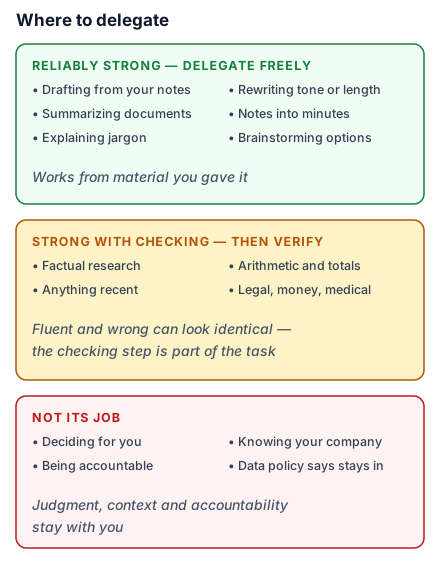
Reliably strong — delegate freely. Drafting anything from notes. Rewriting for tone, length, or audience. Summarizing documents you provide. Turning mess into structure: bullet points into minutes, a rant into a professional email, a transcript into action items. Explaining unfamiliar terms, formulas, or jargon. Brainstorming options when you are stuck at zero. In this zone the model works from material you gave it, which is exactly where it shines.
Strong with checking — delegate, then verify. Factual research, where it can be fluent and wrong in the same sentence. Arithmetic and totals, where it works like a sharp person in a hurry — right method, occasional slips. Anything involving recent events, because a model's built-in knowledge has a cutoff date. Legal, financial, or medical territory, where it is a useful explainer and a dangerous adviser. The rule in this zone is simple: use the output, but make the checking step part of the task, and lessons 8 and 12 will show you exactly how.
Not its job. Deciding for you. Knowing anything about your company it wasn't told in the conversation. Being accountable — "the AI said so" has never once survived contact with an auditor. And anything your organisation's policy says must not leave the building, which lesson 11 treats properly.
The intern with infinite patience
Here is the mental model this whole course rests on: treat the assistant like a brilliant intern on their first day — every day. Brilliant, because it writes faster than you, has read more than you, and never resents a tenth revision. First day, because it knows nothing about your company, your context, or your standards until you tell it, and it would rather guess confidently than admit confusion. Nobody hands an intern's unreviewed work straight to a client; nobody should hand an assistant's unreviewed work anywhere either. Everything that follows — how to brief it, how to iterate, how to check it — is just good intern management.
Do this today: pick one task from the "reliably strong" zone that is sitting in your queue right now — a draft, a rewrite, a summary — and hold it in mind. It becomes your test case in the next lesson.