Writing ad creative with AI
Last lesson ended on the sharpest fact in modern advertising: the machine finds the people, so creative is the lever you actually hold. And creative for ads is a numbers game with a special property — you never know in advance which angle works. The brand-voice caption you love may lose to a plain testimonial; the emotional story may lose to a price point. Professionals don't guess better than you; they test more than you. AI's gift here is making variety nearly free — this lesson is the system for spending that gift well.
The grid: angles × formats, never n copies of one guess
The amateur move is generating ten versions of the same idea — ten rewordings of one guess. The professional move is a testing grid: distinct angles down one side, formats across the other, so every cell is a genuinely different hypothesis about why someone buys.
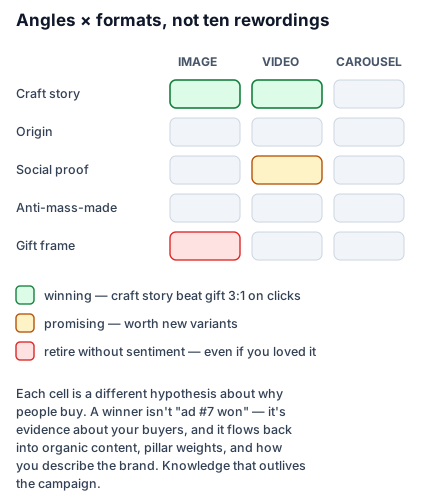
Angles first — ask the model to help you enumerate, because this is a variety task (lesson 4's engine, aimed at persuasion): the craft story (three days, one block), the origin (from our Jaipur workshop to your home), social proof (what buyers say when the lamp arrives), the anti-mass-produced stance (machine-made is everywhere; this isn't), the gift frame (the housewarming present that means something). Five angles, honestly different. Then the ask:
Voice doc applies. For each of these 5 angles, write ad copy for Meta:
primary text (under 125 chars before truncation), headline (under 40),
description. Give me 2 variants per angle. Flag anything that sounds
like a claim we'd need to prove.
Thirty pieces of copy in two minutes — a fortnight's creative pipeline, and the last line matters: ad platforms and advertising standards both punish unprovable claims, so let the model mark its own risky lines for your judgment (India's ASCI rules land properly in lesson 12). Pair the copy with your real photos and videos per lesson 5's law — the imagery in ads faces even harsher truth-tests than organic, because strangers, unlike followers, extend no benefit of the doubt.
Read results like a scientist, not a fan
Run the grid modestly — even five angles × one format at launch — and let the machine allocate (lesson 7). Then the discipline: you are testing angles, not artworks. When the craft-story angle beats the gift angle 3-to-1 on clicks, that's not "ad #7 won"; that's evidence about why people buy from you — knowledge that outlives the campaign and flows backward into organic content, the calendar's pillar weights (lesson 3), even how you describe the brand (lesson 1's paragraph, now with data). Ask your assistant to run the review: paste the per-ad numbers and "which angles won, what does that suggest about our buyers, and what should the next grid test?" Winning angles get new variants and deeper exploration; losing angles get retired without sentiment — including, especially, the ones you personally loved. The grid's whole value is that it argues with your taste using strangers' money-backed votes, and lets you lose those arguments cheaply.
Note what happened across these two lessons: the ad platform's AI owns delivery, your assistant owns variety and analysis, and the irreducible human core — offer, taste, honesty, judgment about what the results mean — is exactly the shortlist from lesson 1. The pattern is holding, and it will hold for every tool the next years ship.
Do this today: build your five-angle list for whatever you'd advertise first — with the model's help brainstorming, your judgment culling — and generate the grid's copy. Even if you never spend a rupee, run the exercise: articulating five different reasons someone buys from you is worth more than most branding workshops, and the copy works organically too.