A brand voice AI can follow
Ask an assistant for an Instagram caption and you will get one — cheerful, competent, and identical in flavour to a million other captions generated that day. This is the single most common complaint about AI marketing content, and it is almost never the model's fault. The model has a thousand voices and you didn't specify one, so it used the average. The fix is a voice document: a half-page brief that turns "write a caption" into "write a caption as Kesar & Co." — built once, pasted forever. This lesson builds yours.
The five-part voice doc
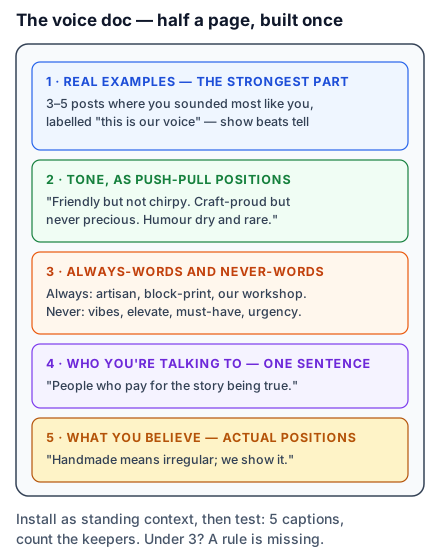
Three to five real examples you're proud of. The strongest section by far — models imitate patterns far better than they follow descriptions (show beats tell, every time). Pull the three captions or posts where you sounded most like yourself, label them "this is our voice", and half the work is done.
Tone, as positions not adjectives. "Friendly but not chirpy. Craft-proud but never precious. Plain sentences; no exclamation marks; humour dry and rare." Push-pull pairs work because they fence the voice from both sides — every brand says "authentic"; the fences are what the model can actually obey.
Always-words and never-words. Vocabulary is voice: Meera's doc says always "artisan", "block-print", "made in our workshop"; never "vibes", "elevate", "must-have", "girlboss", and never an emoji (her choice — yours may differ, but make it a rule either way, because the model's default is emoji confetti).
Who you're talking to. One honest sentence: "Urban Indian women 28–45 who care where objects come from and will pay for the story being true." Aim changes voice automatically.
What you believe. Two or three actual positions: "Handmade means irregular, and we photograph the irregularities." Opinion is what separates a voice from a style — and it is the part AI most needs handed to it, because it has none.
Install it, then test it
A voice doc you paste every time is a voice doc you'll abandon by Thursday. Install it as standing context instead: a Claude Project or custom GPT holding the doc (plus your product list and current campaigns), or your assistant's custom-instructions field. Set up once, and every future chat starts already speaking Kesar. (The everyday-work course covers this machinery in depth in its lesson 10, if you want the fuller treatment.)
Then run the acceptance test: ask for five captions for a real product, and count how many you'd post with only light edits. Fewer than three? The doc is missing something — usually more real examples, or a rule you're enforcing in your head but never wrote down. Add what's missing and rerun. Meera's second pass caught that the model kept adding urgency ("only 3 left!") — a tactic she hates — so "never manufacture urgency" went into the never section, and the third batch came back clean. This loop is the method: every generic output is a missing rule, every missing rule goes in the doc, and the doc converges on your voice within a week of normal use.
One warning about drift, because it's sneaky: the model pulls toward average in long sessions even with the doc installed — smoother, safer, slightly more beige each time. When you notice it, don't argue with the chat; start a fresh one (standing context makes this free) and the voice snaps back. And keep the final read yours: the doc gets the model to ninety percent, and the last ten percent — the word only you would choose — is the moat from lesson 1.
Do this today: build the doc — five sections, half a page, forty-five minutes — install it as standing context, and run the five-caption test. This is the highest-leverage hour in this entire course; everything after assumes it exists.