Why it makes things up
You now hold every piece needed to understand AI's most famous flaw. An assistant states, with perfect composure, a fact that is not true — a court case that was never filed, a book your favourite author never wrote, a settings menu your phone doesn't have. The industry word is hallucination, and the word is well-chosen in one way: the model isn't lying to you. Lying requires knowing the truth and choosing otherwise. What is actually happening is stranger, and this is the lesson where the whole course clicks together.
Plausibility has no truth needle
Assemble the pieces. The machine's single native skill is producing text that plausibly continues (lesson 1). Its knowledge is a compressed blur with no page numbers, where well-worn facts sit deep and rare ones wobble (lesson 5). And its manner was tuned by human approval, which rewards fluent confidence (lesson 6). Now ask that machine something at the edge of its blur — an obscure case, a niche API, your specific phone model — and watch what it must do: produce the most plausible-sounding continuation available. When the blur holds the answer, plausible coincides with true. When it doesn't, the machine does not hit a wall, feel a gap, or reach for "I don't know" — it produces what the answer would look like. A citation with a real journal's name and a fabricated title. A settings path shaped exactly like real settings paths. The counterfeit is high-quality because counterfeiting is, in a precise sense, the machine's actual craft: it has never done anything else.
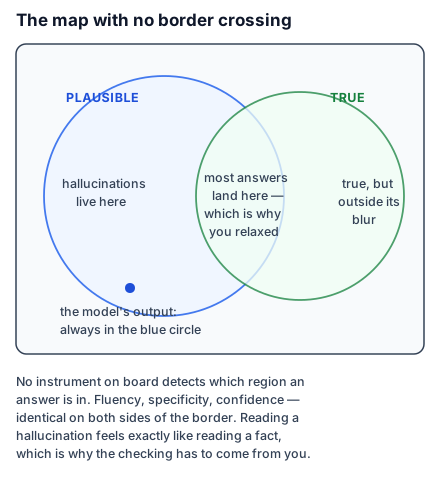
The diagram is the one to keep. The model's entire output lives in the plausible territory. Most of that territory overlaps with the true — which is why the assistant is right so often that you relax — but the model has no instrument that detects which region it's currently in. Fluency, specificity, confidence: all identical on both sides of the border. The feeling of reading a hallucination is the feeling of reading a fact. That sentence is the single most protective thing this course can give you.
Why the obvious fixes aren't easy
"Just make it say 'I don't know'." The genuinely hard part: the model doesn't reliably know that it doesn't know — the blur returns its best continuation without an attached confidence gauge, and a wobbly memory surfaces feeling much like a solid one. Training pushes in both directions at once, too: lean the model toward caution and it starts refusing things it actually knows (annoying everyone); lean toward helpfulness and fabrication creeps back. Vendors tune along this dial constantly, and models as of mid-2026 hedge far more honestly than their 2023 ancestors — but the dial is a trade-off, not a fix, because it's plausibility all the way down.
"Just make it check its sources." Better — and that's literally the design of retrieval systems (lesson 10 in one picture: fetch real documents first, answer from those) and of search modes. Grounding shrinks hallucination substantially. It doesn't abolish it: the model can still misread, over-summarise, or blend what it retrieved — now with a real link attached, which raises your confidence. Even the fixes need the habit.
Living with it, calibrated
The mature stance is neither trust nor boycott — it's knowing where the border runs. Risk is low when the model works from material you handed it (summaries, rewrites, your data: the everyday-course sweet spot), and when facts are famous and heavily documented. Risk spikes for the specific, the recent, the obscure, and the high-stakes — precise numbers, exact names, niche procedures, anything where being confidently wrong costs money or safety. For that territory: search mode on, sources clicked, and the checking habits your stakes deserve. None of this is exotic — it's how you already treat a brilliant colleague with a known tendency to bluff. You just needed to know the tendency is structural.
Try this in your chatbot: pick a real niche you know deeply — your street's history, a game's obscure rule, your industry's paperwork — and ask five increasingly specific questions, search off. Somewhere in that sequence you will likely watch fluent fact shade into fluent invention with no change in tone. Feeling the border once, in territory where you can't be fooled, is worth the whole lesson.