The one-sentence version
Here is the whole course in one sentence: a system like ChatGPT or Claude is a program trained to predict the next word, scaled up until prediction started looking like understanding. Everything else — the fluency, the coding, the confident wrong answers, the trouble with counting letters — falls out of that one sentence, and by the end of these fourteen lessons you will be able to derive most of it yourself. No math is coming. Plenty of "oh, that's why" is.
Autocomplete, taken seriously
You already know next-word prediction: your phone keyboard does it. Type "see you" and it offers "tomorrow", "soon", "there". A large language model — the technology under every major AI assistant, LLM for short — is that idea taken absurdly seriously: trained on trillions of words until its guess about what comes next became very, very good.
Try the game yourself. Finish this sentence: "The queue at the bank was so long that I ___." You said something like "left", "gave up", or "waited an hour" — and notice what you did not say: "elephant", "quickly", "banana". To predict even this simple continuation you used grammar (a verb phrase fits here), meaning (queues cause waiting and leaving), and life experience (banks, impatience). That is the trick hiding in plain sight: predicting the next word well forces you to know things. You cannot continue "the capital of France is ___" without knowing capitals; you cannot continue a legal contract plausibly without absorbing how contracts talk. Prediction is a test that smuggles in knowledge.
The loop that writes everything
One more mechanical fact completes the picture. The model doesn't write a paragraph in one go — it predicts one word, then goes again, with its own last word now part of the input.
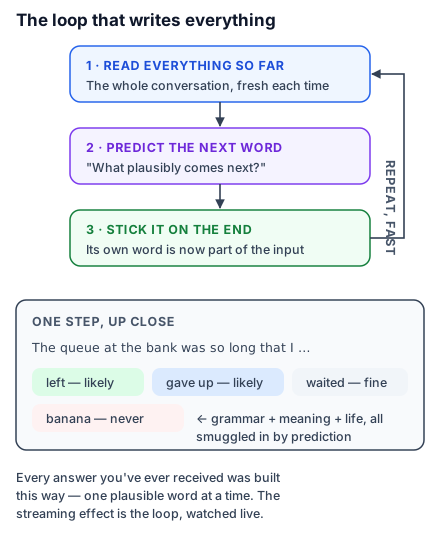
Read everything so far → predict the next word → stick it on the end → read everything again → predict the next. Every answer you have ever received from an AI assistant was produced this way, one word at a time, each word chosen by asking "given everything above, what plausibly comes next?" — thousands of times in a row, very fast. That streaming effect where the answer types itself out? Not a visual flourish. You are literally watching the loop run.
Hold on to the phrase plausibly comes next, because it is doing enormous work. The model's one and only native skill is plausibility. Most of what is plausible in the world's text is also true — which is why the assistant is so often right — but plausible and true are not the same property, and the daylight between them is where every famous AI failure lives. That gap gets its own lesson (lesson 7), and by then you'll see it coming.
Why "just autocomplete" is the wrong sneer
When people first hear this, they swing one of two ways: awe ("it understands everything!") or dismissal ("it's just autocomplete!"). Both miss. The dismissal misses because "just predicting" turned out to require absorbing grammar, facts, styles, reasoning patterns, and forty programming languages — prediction at this scale is a form of competence, and you cannot use the thing for a week and honestly call it a party trick. The awe misses because the competence has a specific shape with specific holes: no fact-checker, no calculator, no memory of you, no idea when it's wrong. This course is a tour of that shape — where the machine's strengths come from and exactly where the holes are.
One sentence will ride along with us the whole way, and it looks innocent: "The parcel doesn't fit in the van because it is too big." What does "it" refer to? You knew instantly. How a next-word predictor comes to know — and what happens when we swap one word — turns out to open the deepest door in the whole machine. That's lesson 4.
Try this in your chatbot: type exactly this — "Continue this sentence with one word: The queue at the bank was so long that I". Then ask it: "List five words that would have been grammatically fine but wildly unlikely there." You've just watched it run its native skill, and explain it.