Finding where it fits: the work audit
Vendors will tell you where AI fits in your operation. Their answer is shaped by what they sell. The audit in this lesson takes about three hours and produces an answer shaped by your actual work, which is the only kind worth having.
List the work, not the roles
Spend an hour with two or three of your people listing what the team actually does, in units of tasks rather than job titles. Not "claims intake" — reading a submitted claim and extracting the details into the system, checking a claim against policy terms, writing the acknowledgement to the customer, chasing missing documents, handling the phone call when someone is angry about a delay.
Kavita's team produced forty-one tasks. That number is typical, and getting to it is most of the value, because it is the first time in years anyone has looked at the work as work.
Involve the people who do it. They know which tasks are tedious, which are error-prone, and which parts of the official process everyone skips. You will not get that from a process document, and it is exactly where the opportunities are.
Score each task on three things
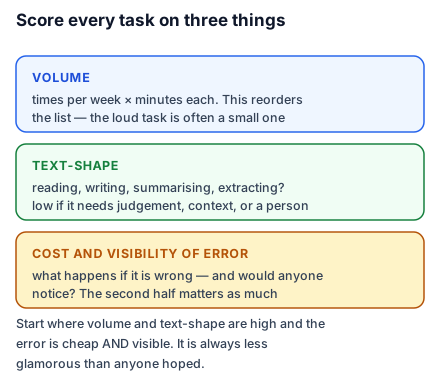
Volume. How many times a week does this happen, and how long does each one take? Multiply. You are looking for total hours, and this reorders things immediately — the task everyone complains about is often forty minutes a week, while the one nobody mentions is eleven hours.
Text-shape. Is this reading, writing, summarising, extracting, restructuring, or classifying language? Score it high if yes. Score it low if it is a judgement call requiring context the system will not have, a physical action, a relationship, or a negotiation. This is where most enthusiasm meets reality: a great deal of work is about text without being text transformation.
Cost of error, and visibility of error. Two halves of one question, and the second matters as much as the first. What happens if this is wrong — and would anyone notice? A wrong draft caught by the person sending it is cheap. A wrong number that flows into a report is expensive precisely because it is invisible.
Where to start
High volume, high text-shape, low and visible error cost. That corner is where a first project belongs, and it is usually less glamorous than what anyone hoped for.
Kavita's top four came out as: drafting acknowledgement letters (high volume, pure text, error caught by the sender), summarising long claim files for a reviewer (high volume, pure text, error visible to the reviewer who has the file), extracting details from submitted claim forms into the system (very high volume, text-shaped, errors visible at the next step if someone checks), and first-pass classification of incoming complaints by type (high volume, text-shaped, misfiling is annoying and cheap).
What did not make it: deciding whether a claim is fraudulent. High value, and it fails on cost of error, on visibility, and on regulatory exposure all at once. It is also the first thing three separate vendors proposed.
The tasks to leave alone, stated plainly
Decisions that affect someone's money, employment, health, or legal position — without a person who makes the decision and can explain it. This is not only a values position; in a growing number of jurisdictions it is a legal one, and lesson 9 covers what you own.
Anything requiring context the system does not have. The customer who has called four times, the vendor relationship that is delicate for reasons in nobody's notes.
Work whose value is the relationship. A difficult conversation is not a text-generation task, and treating it as one is noticed by the person on the other end.
Anything where being wrong is invisible. The scariest column in the audit. If nobody would notice an error, nobody will, and errors accumulate silently until they surface all at once.
The thing the audit tells you that no vendor will
Some of your top-scoring tasks do not need AI. They need a form redesigned, a template written, or a step deleted.
Kavita's document-chasing task — eleven hours a week — was mostly caused by an intake form that did not tell people what to attach. Fixing the form removed most of it. That is a better outcome than automating it, it cost nothing, and no vendor was ever going to suggest it.
Run the audit before you take a single meeting with a vendor. It converts every subsequent conversation from "what can your product do?" to "here are my four tasks — which do you address, and how?" That reversal is worth more than anything else in this course.
Do this today: list ten tasks your team does and score each on volume and text-shape. Ten is enough to see the shape of the answer and takes forty minutes.